
How have the
settlement patterns of Alaska been a reflection of the natural landscape,
distance, resources, and the economy?
 |
| Refugees |
The
movement of people has always been for a reason. Very few people move from a location if it
provides everything they need. In the
past people moved for more food or a safer location, event today this drives many people to leave. Commerce drove the Russians to come to Alaska The first non-native populations were located
at key economic points such as Kodiak Island. These sites gave them access to a
good port, groups of natives that brought furs and resources to provide enough
food to require minimal importation of goods.
We
the start of the American period populations moved for the same reasons as the
Russians, good locations of resources that could earn them a profit. Most of
the first settlements were on the coast taking advantage of the plentiful
natural resources that came from the water.
Whales and fish drove this early economy. These towns were wildly spaced apart and
dotted the southeast coast.
 |
| Ruby Alaska 1913 |
The
Discovery of gold started the shift of people moving inland. Towns rose over night in the gold fields.
Becoming thriving communities only to be ghost towns in a few years. The towns that lasted were the ones that
provided the supplies and communication points for points farther out. Towns like Valdez, Homer and Fairbanks grew
disputed the dramatically shifting populations.
These anchor cities were able to survive because they had steady employment. This was also the reason for the growth of
Anchorage. A city created to provide labor
on the Alaskan Railroad that ended up lasting due to the need of on going
workers after its completion.
The
distribution of population in Alaska has stayed steady since the founding of
Anchorage. The majority of people live
in the Southeast region and despite the discovery of oil in the second half of
the 20th Century the population grew but the distribution did not
change. This is because Anchorage has
the largest population and so the majority of economic opportunities are
there.
 |
| Distribution of population in Alaska |
The University of Alaska Fairbanks is the farthest north
public university in the United States. What are the specialized academic
areas at UAF that make it unique among American universities?
 |
| UAF Logo |
I have been very
impressed with UAF over the years. I had
my first chance to come visit Alaska and more specifically UAF during college
when I was invited to attend a conference of Northwest student leaders. Coming to visit in November was an adventure
compared to the climate of Oregon, but not as much as the students from Hawaii
who had never seen snow. The campus was neat with all the tunnels but it was
the programs that set it apart.

Many of these
programs I have had the opportunity to work with over the past year as I teach
here in Alaska. The specialties that I
have notices are for obvious reasons connected to the arctic. The Sea Ice program, and Glacier program have
made dramatic observations about climate change. Pushing the know boundaries
about ice science. The geophysical
institute based at UAF has spent years integrating western science and native
cultures into a curriculum used around
the state.
Besides science UAF
has pushed to save native languages and taught culturally sensitive
anthropology. The push to bring in
Alaskan natives into school and provide majors that are useful to village life
has been important in the past few years.
 |
| Sea Ice Program |
EXTEND
Are there particular challenges faced by those in your
community related to health care? Feel free to share those.
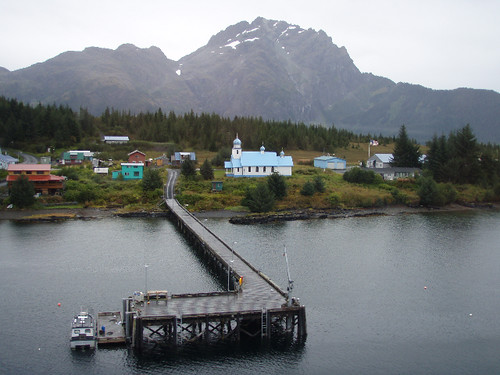 |
| The clinic is behind the red house |
As most of you know my town is very small about 60 people
and so the health care is limited. Being
off of the road system and no regular flights has further complicated regular
health care.
Our community is serviced by a clinic run by the local
corporation. Full time we have a nursing
assistant who can dispense basic medicines and patch minor injuries. They also help with diagnosing anything that
needs to be seen by someone more skilled.
We have a doctor fly in and stay for about 3-5 days once a month and nurses
twice a month. Most care requires people
to be flown out to the hospital in Anchorage and so medical charters are
common.
This system has been difficult for me since my son has
health issues and requires possible access to a hospital at a lot quicker
notice that can usually be provided.
Emergency fights are done by the Coast Guard if the weather is bad but
even then they can be hindered. The limited availability of medical care has forced be to
not renew my teaching contract for next year so that we can be closer to the
larger population areas.
Other Blogs
Peter's Alaska Blog was spot on in his discussion of media and Alaska. While I don't think I ever saw Northern Lights I agree with his point on Alaska as a starting over point. I myself moved up to Alaska looking for a job. The idea of a new place also dove me. Not sure if it was the Simpsons that pushed me or not, could be.
Exploring Alaska's cultures was good this week. I like the part of Alaska in children's story books and I did not realize how often it is referenced even in ones not written by Alaskan writers.
Holly Explores Alaska: First off love the font finally one that I can read without having to move the laptop closer. It was interesting reading about the Ft. Knox Mine. I did not know about it until your blog. While it does bring up environmental issues the economic impact is undeniable.
Reflection
This unit was a quick read and was very interesting to read why people settled in what location. I was surprised to see how many mistakes in the dates and over all editing of the population and settlement reading (not in your blog the linked article). I am a date person and they were off by a century and kept messing with my head. "In the years between 1967 and the Klondike gold rush of 1898 when
thousands of people surged to Alaska, a few new settlements were
founded." Nothing to major, I know that I am guilty of it many times over and over and over. I am looking forward to next weeks module about WWII.

No comments:
Post a Comment