
How is the experience of Russian America an example
of 18th-19th century imperialism and colonialism?
There
are so many aspects of the Russian imperialism, colonialism, occupation that I
wanted to look at an unique one that took place in my region. There is an excellent book called Looking
Both Ways, that discusses the history of the Alutiiq people. This
population one of the first that had contact with the Russians and most of the
trading posts were set up in their homelands.
A
creole
priest from Aleutian Islands, Peter Dobrovolskii
|
I
learned of a unique part of history, that was the establishment of a Creole
class. Many Russian hunters married
into the Native communities. A Creole class was established which included
"descendants of these marriages and others who were assimilated into the
Russian culture without a direct family relationship." In Paul's Harbor,
Russia or Sitka, some Creoles were educated and trained. They served as clerks,
navigators and managers basically an "in between" class. They also were instrumental in helping others
to Russian literacy.
The
Russians also used the Creoles as a portable population. St. Paul Harbor,
Afognak, and Spruce Islands saw Creole families settling there in the 1830's.
In the late 1830's, a smallpox epidemic wiped out a good percentage of the
people. In the 1840's, the Russian company located some Russian and Creole
retirees at Ninilchik on Cook Inlet. There was further relocation after the
epidemic in the 1840's, mainly to places near the Russian posts.
By
establishing a population that they could “trust” and one that was dependent on
them they were better able to manage their business on the edges of the
frontier. This also had a lasting impact
on the native culture here in SE Alaska where I teach Vlassoffs, Totemoffs etc.
What other nations
demonstrated an interest in Alaska? Why?
Russia was not the
only country interested in Alaska, Britain its political rival at times also
had designs on the area. Discovered for
the British in 1778 by Captain James
Cook the famous explore who could also claim to have “found” Hawaii, Australia,
and many other Pacific territories. His reason for exploring the region was
twofold. One reason was to discover a possible northern passage to China in the
hopes of expanding trade. He tried unsuccessfully to enter the Bering Strait
several times and travel farther north. So he headed South back to Hawaii where
he upset some locals and died as a result. The second reason for his Alaskan
adventures was to help establish British claim on the west coast of North
America. During this period just looking at an area could increase your “legal”
right over a territory. His maps of the
area would also allow England to follow up with forts and trading posts. Most
of the trading posts that Britain established were in the interior due to
successful trade routs through Canada.
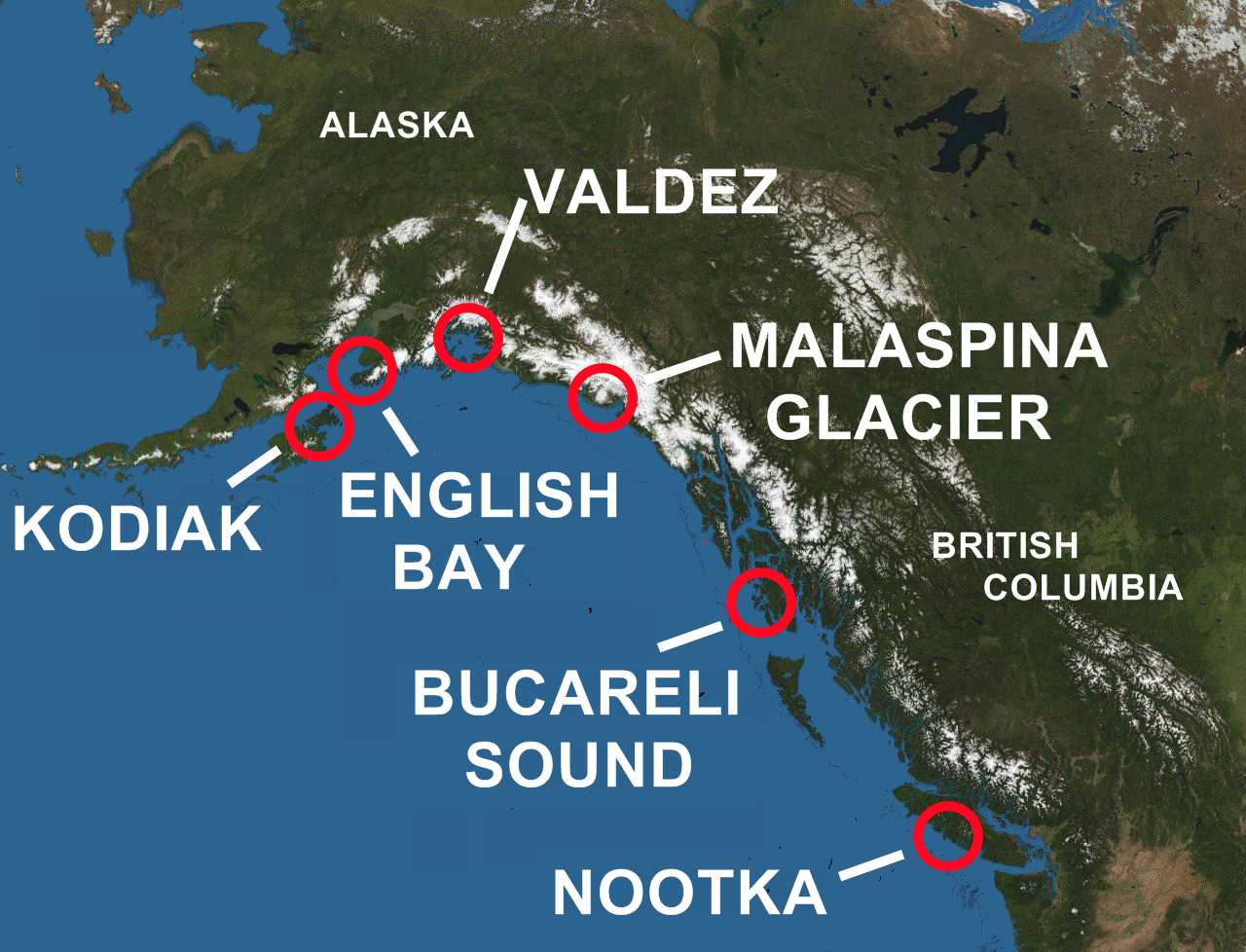
Britain and Russia
was not the only European country interested in Alaska. Spain not to be out
done by its rivals attempted to establish it only control by moving up the
coast from the California area where it had missions. When the Pope finally
resolved the dispute between Spain and Portugal in 1493 it gave Spain all of
the territories west of Brazil. Now no
country was really following this
Papal Bull by the 18th century but Spain sure wanted people to. So
not to be out done the Spanish king sent many different expeditions throughout
the lower part of Alaska. Most of the expeditions just mapped the area looked
for the Northwest Passage but some did come in contact with the Russian trading
posts. All the interactions were
peaceful and in the end Spain realized that an Alaska colony was nonstarter so
left and ceded its claim on the area to the United States in 1819.
See if there is one or more maps or images you'd like to
post on your blog.
Early
Map of North and South America http://vilda.alaska.edu
|
The reason that I picked
this first map is that I am always amazed to think that people would sail out
into the unknown with maybe a map as basic as this and hope to come back. They would go out and fill in those blank
spaces. Maybe strike it rich or go down
in history but the majority would remain unknown.
English
map of Russian voyages. http://vilda.alaska.edu
|
I chose this one with thought this was great propaganda for the Russians. Here is a map printed in English showing
where their explorers have gone and what area they have claimed. The other thought that I had is how detailed
it is. All done by hand and with none of
the modern recording technologies.
Others Blogs
This site did an exceptional job
of explaining culture. I like the parts about resistance and
Assimilation. These sections fit right in with this weeks module on Russian
influence. One has to ask yourself what would I do in that situation. I
would like to say that I would resist but what are the other options?
A very good description of what
Alaskan culture is. I am myself and part of the skin according to his 3
branches. He did well in compressing all of the different aspects of
Alaska in to a easily readable format.
I agreed on her take on
what her culture was. I liked the part of work ethic being something that
she identifies with. That was something that I found was different in the
village.
Reflections
This subject was a
very important one for my community due to the large amount of contact that the
Russians had with them. The resources that were provide did a good job of
painting the whole era. I like the links to the maps and have spent a lot
of time looking around the digital archives. Now that I have a few weeks
under my belt with this blogging thing I think that I am getting better at
it. Will I every want to blog for fun? No!
Ok update I have been trying to upload this for an hour now. I have a flight and I HATE this stupid program. I


"All done by hand and with none of the modern recording technologies."
ReplyDeleteIt is easy to look at the tools of the past and think of people who lived long ago as simpler versions of who we are today. In fact, I believe their skills were often times superior as your comment here shows.
Enjoyed your discussion of Creoles. This was a new term for me this week (in terms of Alaskan/Russian descendants)and is an interesting part of Alaskan history.
ReplyDeleteLane,
ReplyDeleteI was very amused by your comment that during the time that the Europeans were exploring Alaska, all you had to do was look at a piece of land and your legal rights to that place increased. This is so true! I also liked your discussion of Spain's explorations of Alaska. I never knew anything about this before.